
The relationship between what we eat and how our bodies change over time is not a simple ledger. Calories matter. But the ways in which they matter — and the conditions under which calorie awareness becomes a genuinely useful tool rather than a source of confusion — are more intricate than a number on a packet suggests. A considered view of food and weight begins not with restriction, but with understanding.
What Calorie Awareness Actually Means
Calorie awareness is not the same as calorie counting. The distinction matters. Counting involves tracking discrete numbers throughout the day — a habit that, for many people, creates friction, anxiety, or an adversarial relationship with food. Awareness, by contrast, is the broader capacity to understand the approximate energy density of different foods and to use that understanding as a background signal rather than a foreground task.
A person with developed calorie awareness understands, without computation, that a large bowl of lentil soup occupies a different category than a similar-sized bowl of granola-topped yoghurt with honey. Not because one is good and the other bad, but because the energy density differs considerably — and so does the likely effect on hunger signals across the following three hours.
Research consistently finds that people underestimate the calorie content of meals served in larger portions or in unfamiliar formats. Awareness training — through reading ingredient labels, cooking at home, and developing familiarity with portion perspective — tends to close this gap over time. The evidence suggests this is a learnable orientation, not an innate capacity.
"The aggregate pattern across weeks matters more than any single meal. Calorie awareness supports the pattern; it does not replace it."
Energy Density and Nutrient Density: Two Different Axes
Energy density describes how many calories are packed into a given weight of food. Nutrient density describes how many vitamins, minerals, and other beneficial compounds are present relative to the calorie count. These two axes are often confused or conflated, but they operate independently.
A food can be low in energy density and low in nutrient density — iceberg lettuce, for instance, provides very few calories but also contributes limited nutritional value. A food can be high in energy density and high in nutrient density — walnuts are a clear example: calorie-dense, but rich in unsaturated fats, protein, magnesium, and polyphenols. The challenge with applying calorie awareness without nutrient density awareness is that it can inadvertently steer people away from whole food choices that serve their long-term eating rhythm, and toward low-calorie options that offer poor nutritional return.
The practical resolution is to orient primary food choices toward whole foods — vegetables, legumes, whole grains, lean proteins — that tend to be simultaneously nutrient-dense and moderately energy-dense. Within this category, portion perspective becomes the relevant variable rather than calorie elimination.
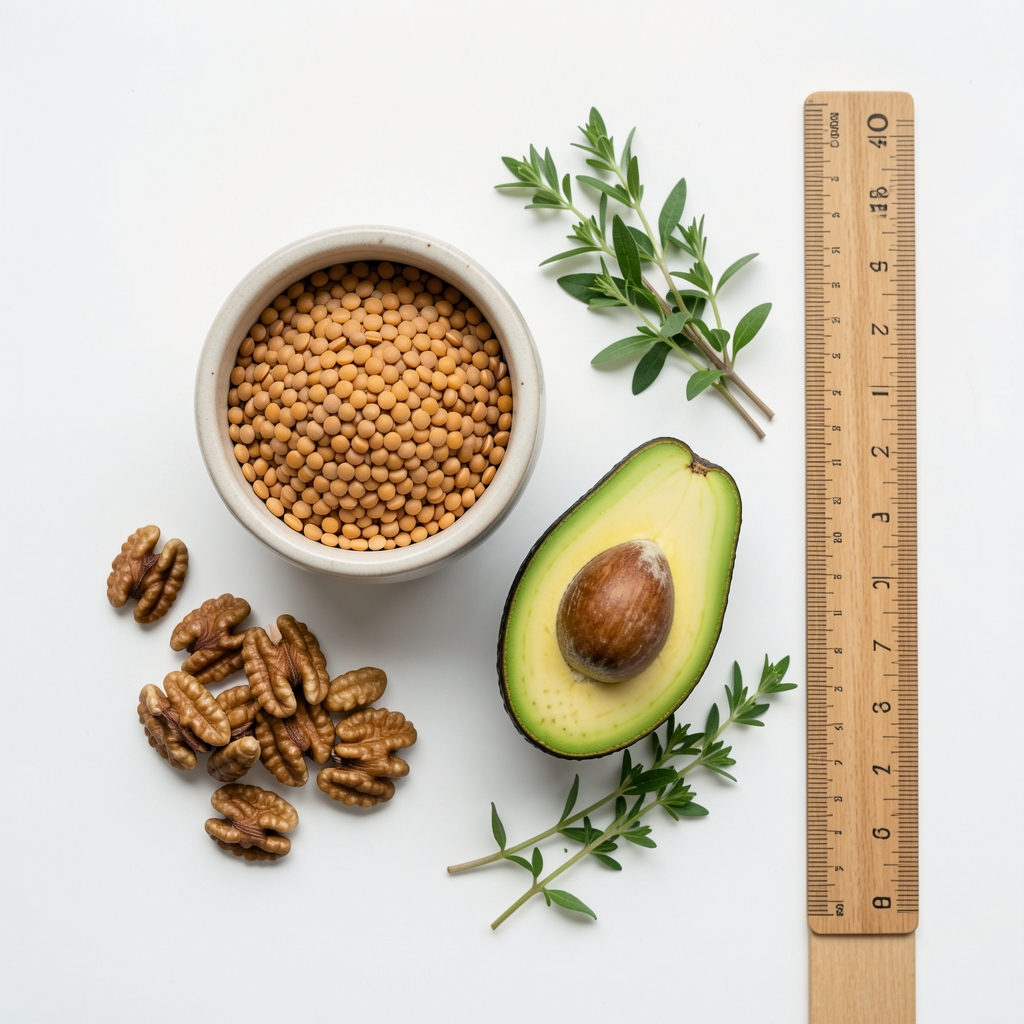
Comparing nutrient density across whole food choices — London studio, January 2026
Meal Timing and the Daily Eating Structure
When calories are consumed — not just how many — appears to play a meaningful role in how the body manages energy balance. Research into meal structure and weight has grown considerably in the past decade, examining how aligning food intake with the body's internal rhythm affects both appetite regulation and longer-term weight outcomes.
The broad finding is that front-loading calories — consuming more of the day's energy in the earlier hours — is associated with improved appetite regulation and, in some studies, with more favourable body composition outcomes over time. The mechanism proposed relates to the timing of insulin response and the body's reduced capacity for efficient energy use later in the day, particularly in the hours immediately before sleep.
This does not directs a specific meal structure. Rather, it suggests that a long-term eating rhythm in which the heaviest meal is not consistently the final meal of the day may offer advantages in terms of energy balance. The evidence is still developing, and individual variation is considerable — but the signal is consistent enough to be worth noting.
- 01 Calorie awareness is a learnable orientation — familiarity with portion perspective develops through engagement with whole food preparation.
- 02 Energy density and nutrient density are separate qualities; prioritising nutrient-dense whole food choices serves long-term eating rhythm without requiring strict calorie restriction.
- 03 Meal structure and weight outcomes appear meaningfully connected; distributing energy intake earlier in the day aligns with how the body manages food over time.
- 04 Processed food awareness matters because highly processed items tend to compress high energy density with low nutrient density — the opposite of a balanced plate approach.
Processed Food Awareness and the Quality Dimension
Understanding calorie awareness in isolation from food quality is incomplete. Highly processed foods are often engineered to be both energy-dense and to resist satiety signals — their combinations of fat, refined carbohydrates, and added sugar exploit the body's reward circuitry in ways that whole foods typically do not. This is not a moral judgement; it is a description of how these products function within an eating pattern.
The significance of processed food awareness for weight management lies not in individual consumption events but in the proportion of highly processed items within the weekly food rhythm. Population studies consistently find that diets with higher ultra-processed food proportions are associated with higher overall energy intake — even when people report similar hunger levels. The mechanism appears to involve both the disruption of hunger signals and the reduced satiety per calorie that processed foods tend to provide.
This aligns with the broader principle of food quality over quantity: that shifting the composition of what is eaten — toward whole grain benefits, fibre and fullness, and adequate protein — tends to regulate energy intake more gently and more sustainably than direct calorie restriction applied to an unchanged food quality profile.
The Long View: Patterns Over Events
Weight, understood over months and years rather than weeks and days, is shaped by the accumulated effect of eating patterns rather than by isolated choices. This is both liberating and demanding: liberating because no single meal determines an outcome; demanding because the aggregate matters and cannot be indefinitely ignored.
The research on long-term eating rhythm points toward a few consistent characteristics of eating patterns associated with stable weight over time: a high proportion of whole food choices, moderate and consistent portion perspective, sufficient protein and fibre intake, and a weekly food rhythm that does not oscillate dramatically between restriction and excess.
Calorie awareness, in this context, is best understood as a background instrument — useful for developing intuition about food composition, but not intended as a continuous accounting exercise. The goal is a relationship with food that is attentive without being anxious, structured without being rigid. That is what the long view on weight requires.
Articles published on Balvora Gazette are editorial in nature and reflect the writers' observations on everyday wellness practices. The content is not intended as professional advice, nor as guidance for the management of any specific condition. Readers with specific concerns about their daily routines are encouraged to speak with a qualified wellness professional.